Bayesian Statistics HW1
1.1
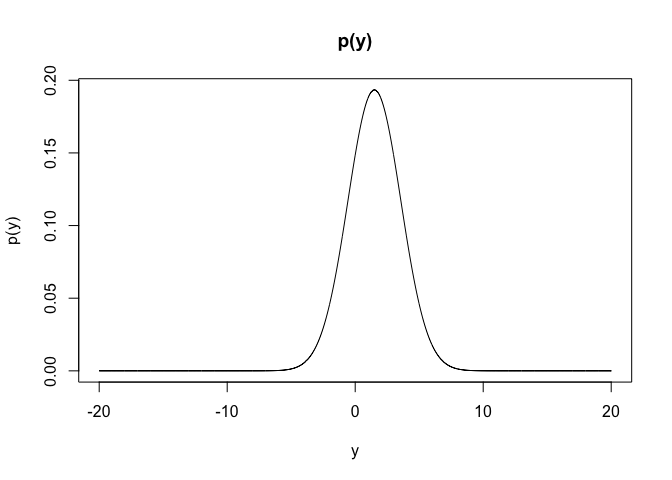
(a) For \(\sigma=2\), write the formula for the marginal probability density for \(Y\) and sketch it.
y <- seq(-20,20,0.01)
py <- 0.5*dnorm(y,1,2)+0.5*dnorm(y,2,2)
plot(y,py,type='l',main='p(y)',xlab='y',ylab='p(y)')
(b) What is \(P(\theta=1|y=1)\) again supposing \(\sigma=2\)?
By bayes theorem,
$\(P(\theta=1|y=1)=\frac{P(\theta=1,y=1)}{f(y=1)}\)$ $\(=\frac{P(\theta=1)f(y=1|\theta=1)}{\sum_\theta{P(\theta)f(y=1|\theta)}}\)$ $\(=\frac{0.5N(1|1,2^2)}{0.5N(1|1,2^2)+0.5N(1|2,2^2)}\)$ $\(=\frac{1}{1+exp(-1/8)}\)$ (c) Describe how the posterior density of \(\theta\) changes in shape as \(\sigma\) as increased and as it is decreased.
If as \(\sigma \rightarrow \infty\),
As \(\sigma \rightarrow \infty\),
$\(1,\ y< 3/2\)$ posterior density \(P(\theta|y)\) goes to prior \(P(\theta)\) if \(\sigma\) goes to infinity,
and if \(\sigma\) goes to zero, posterior density \(P(\theta|y)\) will have high variability which depends on data.
1.2 Show that (1.8) and (1.9) hold if u is a vector
Suppose \(\mathbf{U} = (U_1,..,U_n)^T \in \mathbf{R^n}\) is n-dimensional random vector.
Then \(E(\mathbf{U})= (E(U_1),..,E(U_n))^T=(E(E(U_1|V)),..,E(E(U_n|V)))^T\). Then (1.8) still holds for vector \(\mathbf{U}\)'s components.
(1.9) also holds for diagonal elements \(V(U_i)=E(V(U_i|V))+V(E(U_i|V))\) and also for off diagonal elements.
$\(=E(E(U_i,U_j|V)-E(U_i|V)(E(U_j|V)) + E(E(U_i|V)E(U_j|V))-E(E(U_i|V)E(U_j|V))\)$ $\(=E(U_i,U_j)-E(E(U_i|V)E(U_j|V))+E(E(U_i|V)E(U_j|V))-E(E(U_i|V)E(U_j|V))\)$ $\(=E(U_i,U_j)-E(U_i)E(U_j)=Cov(U_i,U_j)\)$.
1.3
1.4
(a).
$\(P(favorite\ wins\ by\ at\ least\ 8|point\ spread=8\ and\ favorite\ wins)=\frac{5}{8}\)$ (b). Let d= (outcome-point spread). Then \(d \approx N(\bar{d}=-1.25,s^2=(10.1^2))\)
1.5
(a).
Our goal is guessing probability \(P(election\ is\ tied|given\ information)\).
Assume that in two party, each candidate receives between 30% - 70% of the vote that follows Uniform distribution (\(\frac{y}{n} \sim Unif(0.3,0.7)\)).
Then we can express
$\(P(election\ is\ tied|n)= P(\frac{y}{n}=0.5) = 1/0.4n,\ n\ is\ even,\ o.w\ zero\)$ n is the total number of votes and y be the number received by candidate.
We can write \(P(election\ is\ tied,n=even)= P(election\ is\ tied|n=even)P(n=even)= \frac{1}{0.8n}\)
National election has 435 individual districts, then the probability of at least one of them being tied is,
as n goes to infinity.
(b).
Given information implies \(\hat{P}(election\ decided\ within\ 100\ votes)=\frac{49}{20597}\) and
vote gap written as \(|2y-n| \leq 100\).
Let \(d=\ 2y-n,\)
$\(=\frac{1}{100-(-100)+1}\frac{49}{20597} = \frac{1}{201}\frac{49}{20597}\)$.
By using (a),
1.6
1.8
(a).
Person A already saw rolled die, then his belief about probability about issue is updated and will be biased. This situation seens to have subjectivity, but i think, if two people A and B's are both rational persons, A & B build same probablity about 6 appears as 1/6.
(b).
A and B have different belief about soccer. B's knowledge about soccer affect hisb belief about probability, then B allocate probablity about Brazil's win more higher than A, who will allocate probability about all countries equally.
1.9
(a).
simulation = function(seed=NULL){
  if(!is.null(seed)){
    set.seed(seed)
  }
time <- cumsum(rexp(50,1/10))
time <- time[time <= 420]
patients <- length(time)
wait_pat <- 0
wait_time <- 0
doc <- c(0,0,0)

for (i in (1:length(time))){
  wait <- max(min(doc)-time[i],0)
  wait_time <- wait_time + wait
  wait_pat <- wait_pat + (wait > 0)
  doc_start <- max(c(min(doc),time[i]))
  doc_end <- doc_start + runif(1,5,20)
  doc[which.min(doc)] = doc_end
}

result <- c('patients'=patients,'wait_pat'=wait_pat,
            'avg_wait_time'=avg_wait_time <- ifelse(wait_pat==0,0,wait_time/wait_pat)
            ,'hospital_closed'=hospital_closed <- max(max(doc,420))
)
return(result)

}

simulation(2020311194)
##        patients        wait_pat   avg_wait_time hospital_closed
##       47.000000        4.000000        3.958816      428.354702
(b).
iteration <- replicate(100,simulation())

q25 <- apply(iteration,1,quantile,0.25)
q75 <- apply(iteration,1,quantile,0.75)

q25; q75
##        patients        wait_pat   avg_wait_time hospital_closed
##       39.000000        3.000000        2.885335      420.000000
##        patients        wait_pat   avg_wait_time hospital_closed
##       46.000000        8.000000        5.363889      430.994808